Last updated 2026-07-10
TL;DR
California Section 8 inspections use HUD's Housing Quality Standards (HQS), which cover 13 categories from sanitation to smoke detectors. Inspectors check both health-and-safety items and general condition. A unit must pass all 13 before rent payments start. Most California PHAs give landlords 30 days to fix failures before a voucher is at risk.
What is a Section 8 inspection in California and why does it happen?
Every unit rented under the Housing Choice Voucher program has to meet HUD's Housing Quality Standards (HQS) before the local Public Housing Authority (PHA) will sign a Housing Assistance Payments (HAP) contract with the landlord [1]. California has more than 100 PHAs, from the Los Angeles County Development Authority (LACDA) to the Sacramento Housing and Redevelopment Agency (SHRA), and every one of them runs HQS inspections before move-in and at least once during each tenancy [2].
The legal basis is 24 CFR Part 982, Subpart I. Section 982.401 says "the owner must maintain the unit in accordance with HQS," and section 982.405 requires the PHA to inspect every unit before approving a lease and at least annually during the tenancy [1]. California has no separate state-level inspection protocol for Section 8. Everything runs through HQS. What changes from city to city is how fast an inspector shows up, what reinspection fees look like, and how forgiving the PHA is about small stuff.
A failed inspection means the tenant can't move in until the landlord fixes the problems. Payments don't start until the unit passes. That lines up both sides on purpose. HUD wants the tenant and the landlord equally motivated to close out issues fast.
What are the 13 HQS categories California inspectors check?
HUD's HQS sorts every possible deficiency into 13 categories. Inspectors in California score each one as pass, fail, or inconclusive. A single fail in any category fails the whole inspection [1].
| # | HQS Category | Common California failure points |
|---|---|---|
| 1 | Sanitary facilities (bathroom) | Toilet, tub/shower, ventilation |
| 2 | Food preparation and refuse disposal | Working stove, sink, refrigerator, garbage disposal or trash access |
| 3 | Space and security | Doors and windows that lock, unit size minimums |
| 4 | Thermal environment | Working heat to at least 68°F in living areas |
| 5 | Illumination and electricity | Adequate outlets, no exposed wiring |
| 6 | Structure and materials | No serious deterioration, holes in walls, sagging ceilings |
| 7 | Interior air quality | No evidence of mold, carbon monoxide risk, pest infestation |
| 8 | Water supply | Hot and cold running water, no lead service lines where flagged |
| 9 | Lead-based paint | Pre-1978 units require visual assessment; chipping paint triggers further evaluation |
| 10 | Access | Unit has own entrance; not required to walk through another private unit |
| 11 | Site and neighborhood | No immediate hazard from traffic, pollution, or environmental danger |
| 12 | Sanitary conditions | No accumulation of garbage or debris inside the unit |
| 13 | Smoke detectors | Required inside each bedroom and in the hallway adjacent to bedrooms [3] |
California stacks one extra layer on top of HQS: state building code. If a PHA inspector spots a California Building Code violation that also counts as an HQS deficiency, the unit fails on HQS grounds. Pure building-code problems that don't touch HQS don't automatically fail the inspection, but plenty of California PHAs flag them anyway and hand them off to local code enforcement.
Carbon monoxide detectors are now required in all California residential rentals under Health and Safety Code Section 17926, and most California PHAs treat a missing CO detector as a Category 7 (interior air quality) failure [4].
What does a California Section 8 inspector actually look at room by room?
Knowing the 13 categories is one thing. Walking your own unit and knowing exactly where the inspector's eye lands is another. Here's the room-by-room reality.
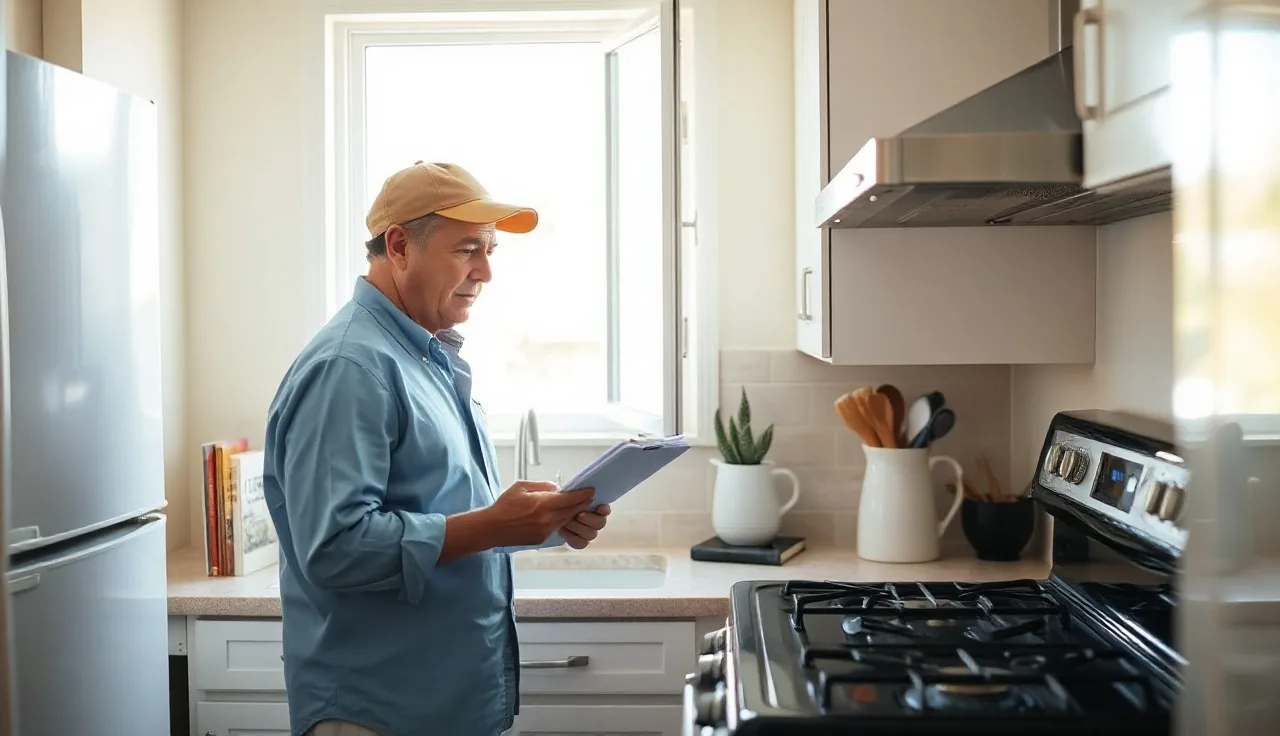
Kitchen. The stove has to have all burners working. A single dead burner is a fail at most California PHAs. The oven door has to close and latch. The refrigerator has to hold safe food temperatures (inspectors usually look for a working unit, not a thermometer reading). The sink needs hot and cold water with no active leak under the cabinet. Ventilation, either a window that opens or a working exhaust fan, is required. Outlets missing cover plates fail.
Bathrooms. The toilet has to flush and not run nonstop. The tub or shower needs hot and cold water and has to drain without standing water. There has to be ventilation: a window that opens to the outside or a working exhaust fan. Missing caulk around a tub surround often gets flagged as a moisture and mold risk.
Bedrooms. Every bedroom needs a smoke detector in the room or the adjacent hallway, per California law [3]. Windows have to open and close, and above the first floor they need a fall-prevention device or a screen. Closets get checked for exposed wiring or open junction boxes.
Living areas. Inspectors check that ceilings are intact, that walls have no holes, and that flooring doesn't have a trip hazard. A worn carpet with a nail strip poking up underneath is a common citation.
Exterior and common areas. The exterior entry has to be secure. Stairways need handrails once they have more than three risers. Ground-floor exterior windows have to lock.
Utilities. Gas shutoff valves have to be reachable. The water heater has to be strapped (an earthquake requirement in California, and most PHAs treat a failure to strap as a structural safety deficiency) [4]. The electrical panel has to be accessible, with no open knockouts and every breaker labeled.
What are the most common Section 8 inspection failures in California?
Based on HUD's own inspection outcome data and PHA guidance documents, five failure triggers show up over and over in California:
1. Missing or dead smoke detectors. This is the single most common avoidable fail. Buy fresh 9-volt batteries and test every unit the morning of the inspection.
2. Missing carbon monoxide detectors. California Health and Safety Code 17926 requires them in any residential unit with an attached garage or a gas appliance, and nearly every California rental qualifies [4].
3. Inoperable stove burners or oven. A landlord who turns a unit over without testing the whole range will fail.
4. Water heater not seismically strapped. In California this one is almost a running joke. Two metal straps around the tank, lag-bolted to wall studs, per California Plumbing Code Section 507.2 [4].
5. Deteriorated paint in pre-1978 units. HUD's lead-based paint rules under 24 CFR 35 require a visual assessment in any pre-1978 housing getting federal assistance. Chipping, peeling, or flaking paint anywhere in the unit or on exterior surfaces a child can reach triggers a lead hazard citation, and it has to be fixed with stabilization or encapsulation before the unit passes [5].
If you want the broader national picture of what inspectors look for, the HUD housing inspection checklist and what do Section 8 inspections look for articles walk through it. California's failures track the national list closely, but the CO detector and water heater strap items get enforced harder here than in states like Illinois or Massachusetts.
How do California inspections compare to inspections in other states?
HQS is federal, so the core inspection is the same everywhere. What changes is enforcement emphasis, timelines, and local add-ons.
Seismic strapping of water heaters and CO detector rules get enforced more strictly in California than in most states, because they're state law rather than a suggestion. Illinois, by comparison, has no statewide CO detector mandate for single-family homes as of 2024, though many Illinois PHAs flag it anyway. Massachusetts runs its own state Sanitary Code (105 CMR 410) alongside HQS, so a Massachusetts unit can fail on a state sanitary violation even if it technically clears HQS. California doesn't run a parallel state code the same way. But California's implied warranty of habitability (Civil Code Section 1941) means a landlord who fixes HQS failures usually clears the habitability claims a tenant could bring at the same time [7].
For landlords wondering whether California inspections are harder or easier than elsewhere: they're about as rigorous as inspections in other large states. The two California-specific gotchas stay the same, the water heater strap and the lead paint visual in older buildings. Landlords renting to voucher holders in older-stock cities like Rochester, NY, face a similar lead paint emphasis (see section 8 housing Rochester NY).
What happens if a California Section 8 unit fails inspection?
A failed inspection doesn't kill the deal. It starts a clock. Most California PHAs give landlords 30 days to correct deficiencies and request a reinspection [2]. Some failures get treated as life-threatening or emergency deficiencies: exposed electrical wiring, no heat in cold weather, vermin infestation, or a nonworking toilet. Those have to be corrected within 24 hours.
If a unit fails reinspection, the PHA can abate (suspend) HAP payments and eventually terminate the HAP contract. The tenant usually gets a chance to move to another unit with the voucher still intact. For the full sequence, the what happens if you fail a Section 8 inspection guide covers what both sides should do at each stage.
Tenants, you have rights here. If your current landlord fails an annual inspection and won't make repairs, call your PHA and ask about the abatement and relocation process. California Civil Code Section 1942 also gives tenants a repair-and-deduct option for habitability issues, though that's a separate track from the HQS process [7].
Landlords, never skip a reinspection request. Some California PHAs schedule a second reinspection for free. Others charge a fee (LACDA, for instance, charges for second and subsequent reinspections under its published fee schedule). Read your PHA's administrative plan.
How long before a California Section 8 tenant can move in after inspection?
When a unit passes, most California PHAs process the HAP contract within 3 to 10 business days. The tenant can move in once the HAP contract is signed, the lease is signed, and the PHA confirms the effective date. In practice, most move-ins land within one to two weeks of a passed inspection.
If the unit fails and the landlord fixes it fast, a reinspection can sometimes be scheduled within a week, though some California PHAs are backlogged and take two to four weeks. Voucher expiration dates are a real risk. If the inspect-and-repair cycle drags, the tenant's voucher can expire. Most PHAs grant an extension in writing when the delay comes from inspection scheduling, but the tenant has to ask, and ask early. The how long after Section 8 inspection can I move in article goes deeper on what pushes the timeline either way.
How should a California landlord prepare for a Section 8 inspection?
The fastest way to pass is to run your own walkthrough with the exact checklist the inspector uses, before the appointment. HUD publishes the full HQS inspection form (form HUD-52580), and it's the literal form inspectors carry [1].
Here's a prep sequence that works for California landlords:
Two weeks before: Walk the whole unit with a flashlight. Check every outlet cover plate. Turn on every burner, open the oven, run all faucets. Flush toilets. Open and close every window and door. Note anything that sticks, leaks, or sparks.
One week before: Buy and install fresh smoke detectors if any are missing or over 10 years old (California law requires replacement at 10 years). Install CO detectors in every required spot. Have a plumber or handyman strap the water heater if it isn't already.
Day before: Clean the unit so there's no garbage buildup (Category 12 fail). Confirm the electrical panel is accessible and has no open knockouts. Test the front door deadbolt. If the unit was built before 1978, hunt for peeling or chipping paint and either stabilize it yourself (paint over intact edges) or call a certified renovator.
Morning of: Test every smoke detector battery. Leave the utilities on. Be there, or have someone there, to let the inspector in.
VoucherReady's landlord kit has a printable version of this sequence as a yes/no checklist you can hand a maintenance crew, at voucherready.com. Tenants who want to know what standard the landlord is held to should read section 8 inspection guidelines for tenants.
What are California-specific rules that differ from the federal HQS baseline?
Several California statutes create inspection obligations that go past or sit alongside HQS.
Smoke detectors: California Health and Safety Code Section 13113.7 requires smoke alarms in every bedroom, outside each sleeping area, and on every floor. New construction or major renovation after 2014 can't use battery-only alarms; those have to be hardwired with a battery backup. Most existing rentals can still use battery-only alarms, but if your unit has been heavily renovated, confirm your detector type [3].
Carbon monoxide detectors: Health and Safety Code Section 17926 covers every dwelling unit with a gas appliance, attached garage, or fireplace, which is nearly every California rental. A CO detector has to sit in each area next to a sleeping area [4].
Water heater strapping: California Plumbing Code Section 507.2 and Chapter 13 of the California Residential Code require water heaters to be anchored or strapped to hold up during a seismic event. Two straps, upper and lower third, lag-bolted to studs [4].
Lead-based paint: 24 CFR Part 35 governs the federal requirements. The California Department of Public Health also issues guidance for units getting state or federal housing assistance. Any pre-1978 unit needs a visual assessment before the HQS inspection, and if there's chipping paint, the landlord has to complete lead hazard reduction before reinspection [5].
Bedbug disclosure: California Civil Code Section 1954.603 requires landlords to give tenants a bedbug disclosure [9]. Active infestation is an HQS Category 7 fail. It's not a new inspection category, but it makes clear that pest evidence gets taken seriously.
None of these California rules are unique to Section 8. They apply to all rentals. The difference is that an HQS inspection puts a formal, federally-backed enforcement hook behind them. The inspector will cite them.
How do California PHAs handle annual and special inspections?
The PHA has to inspect every voucher unit at least once every 24 months. Most California PHAs still run annual inspections, though HUD's 2023 rule change under HOTMA (the Housing Opportunity Through Modernization Act) lets PHAs move to a biennial cycle for units with a clean pass history [2].
Beyond the scheduled annual or biennial inspection, two other types matter.
Special (complaint) inspections. If a tenant reports a habitability problem to the PHA, the PHA can schedule an unannounced or short-notice special inspection. Tenants have the right to request one. Landlords can't retaliate for a tenant-requested inspection under California Civil Code Section 1942.5 [8].
Quality control inspections. HUD requires every PHA to reinspect a sample of previously-passed units to confirm its frontline inspectors are scoring consistently. These usually go unannounced to tenant and landlord, and they're about checking the PHA's own inspector, not the unit. For more, see what is a quality control inspection for Section 8.
Move-out inspections. HQS doesn't govern move-out inspections the way a landlord-tenant security deposit walkthrough does. But if a landlord wants to re-rent to another voucher holder, the unit has to pass a fresh HQS inspection before the next HAP contract gets signed. Landlords sometimes get caught off guard when a returning inspector finds wear that piled up during the tenancy.
The inspection list for Section 8 housing article maps the full HUD form to plain-language descriptions if you want to see how each line item is scored.
What should a California Section 8 tenant do if their unit is failing conditions?
You're not a bystander in this process. Here's what you can actually do.
Start by documenting everything. Photos with timestamps, written notes, every message to the landlord asking for repairs. California landlords have a legal duty to keep the unit habitable under Civil Code Section 1941, separate from HQS [7].
Next, contact your PHA in writing and request a special inspection. The PHA has to follow up on tenant complaints about housing quality. Most California PHA administrative plans have a specific complaint intake process, so call or email the inspections department directly, not the main line.
Third, if the problem is urgent (no heat, active sewage backup, pest infestation, exposed wiring), you may have the right to repair and deduct the cost from rent under Civil Code Section 1942, as long as the problem isn't your fault and you've given the landlord written notice plus reasonable time to fix it [7]. Get advice from a tenant legal services group before you do this. The rules are specific.
Fourth, if the PHA abates payments over the landlord's failure and the landlord still won't fix the unit, ask your caseworker about a special voucher issuance that lets you move. Some California PHAs will issue a new search voucher in that spot.
Wondering how the process should look when things go right? Compare your situation against the what happens after you pass Section 8 inspection guide and use it as a baseline for what you're owed.
Can a landlord or tenant reschedule a California Section 8 inspection?
Yes, but there are limits and costs.
Landlords can usually reschedule an initial inspection with 24 to 48 hours' notice at most California PHAs. Rescheduling the day of, or a no-show, often means a missed-appointment fee (HACLA, for example, charges for missed inspections under its administrative plan) and can eat into the time left before the tenant's voucher expires.
Tenants can ask to reschedule an annual inspection for a real conflict, but they can't stall a required HQS inspection forever. The PHA can eventually run the inspection without the tenant present, as long as the landlord provides access.
If you need to reschedule, the reschedule Section 8 inspection guide covers the steps at most PHAs and what documentation helps your case.
One practical point. If the inspection has to move because the unit isn't ready, it's almost always better for the landlord to call ahead and cancel than to let the inspector show up to a unit that will obviously fail. Most California PHAs will work with landlords on timing for the initial inspection, and less so after a first failure.
VoucherReady has a free inspection-date tracking tool at voucherready.com that lets tenants log their inspection date and set reminders for the required follow-ups.
Frequently asked questions
Does California have its own Section 8 inspection form separate from HUD's?
No. California PHAs use HUD's standard HQS inspection form (HUD-52580) [1]. What varies by PHA is the administrative process around it: fee schedules, reinspection timelines, and how quickly inspectors are dispatched. California adds state-law requirements like CO detectors and water heater seismic strapping, but these are evaluated through the same federal HQS categories, not a separate form.
How long does a California Section 8 inspection take?
A typical HQS inspection for a one- or two-bedroom unit takes 30 to 60 minutes. Larger units, pre-1978 construction with a required lead paint visual, or units with obvious deficiencies that the inspector needs to document in detail can take up to 90 minutes. Inspectors generally move room by room and test every fixture they can reach.
Can a tenant be present during a Section 8 inspection in California?
Yes, and it's usually a good idea. The tenant can point out things that aren't working and ask the inspector what will be cited. But the inspection isn't a negotiation. The inspector scores each item against HQS standards. The landlord has to be present or have a representative with access to the unit; the tenant's presence is optional but often helpful for spotting issues the inspector might miss.
What happens to my voucher if the unit fails and the landlord won't fix it?
The PHA will abate (stop) HAP payments to the landlord after the correction deadline passes. If the landlord still won't repair, the PHA terminates the HAP contract. The tenant's voucher stays active. Most California PHAs will issue a new search period so the tenant can find another unit. Contact your PHA caseworker immediately if you're in this situation; voucher expiration dates still apply.
Do smoke detectors need to be hardwired to pass a California Section 8 inspection?
Not necessarily for existing units. California Health and Safety Code Section 13113.7 requires hardwired detectors only in units where significant renovation has triggered new construction standards [3]. For most existing rentals, battery-operated smoke alarms are acceptable as long as they function, are present in all required locations (each bedroom, outside each sleeping area, every floor), and have working batteries on the day of inspection.
Is a landlord required to strap the water heater for a California Section 8 inspection?
Yes. California Plumbing Code Section 507.2 requires water heaters to be seismically strapped, and California PHAs treat an unstrapped water heater as a structural or safety deficiency under HQS [4]. Two metal straps, one in the upper third and one in the lower third of the tank, lag-bolted to wall studs, satisfy the requirement. Hardware kits cost roughly $15 to $30 at any hardware store.
How do I find out which California PHA handles inspections for my city?
HUD maintains a searchable PHA directory at hud.gov [2]. Enter your city or county, and it will return the PHA with jurisdiction over that area. In California, some cities have their own PHA (like HACLA for Los Angeles City) while unincorporated areas fall under the county PHA. Your landlord should confirm with the correct PHA before listing a unit, since jurisdiction determines who schedules and runs the inspection.
What qualifies as a life-threatening HQS deficiency in California?
HUD defines certain HQS failures as emergency or life-threatening: no working heat when outdoor temperatures are below a threshold, exposed electrical wiring, active sewage backup, blocked fire exits, active gas leak, or evidence of carbon monoxide hazard [1]. California PHAs require these to be corrected within 24 hours. Failure to correct within 24 hours typically triggers immediate abatement of housing assistance payments.
Does a Section 8 inspection in California check for mold?
Yes, under Category 7 (interior air quality). Inspectors look for visible mold or moisture damage and flag it as a potential health hazard. HQS doesn't require air sampling or lab testing; it's a visual assessment. Significant mold staining, especially in bathrooms or around windows, will fail the unit. The landlord must remediate and pass reinspection before payments resume.
Can a California landlord charge more than the PHA's payment standard by collecting extra rent from the tenant?
Landlords may charge rent above the payment standard, but only up to what the PHA determines is reasonable for the market, and the tenant must pay the difference out of pocket. However, the tenant's share cannot exceed 40 percent of their monthly adjusted income at the time of initial lease-up under 24 CFR 982.508 [1]. Many California PHAs enforce this strictly and will not approve a lease where the math pushes the tenant above 40 percent.
How often does California require Section 8 units to be reinspected?
Federal rules require an HQS inspection at least every 24 months under HOTMA [2]. Most California PHAs still conduct annual inspections, though some have moved to biennial schedules for units with a clean inspection history. Units may also be inspected any time a tenant files a complaint about housing conditions, or when a new HAP contract is being considered after a vacancy.
What's the difference between an HQS inspection and a REAC inspection in California?
An HQS inspection covers individual units rented under the Housing Choice Voucher program. A REAC (Real Estate Assessment Center) inspection is HUD's assessment of project-based Section 8 properties (like multifamily housing with a project-based HAP contract) and public housing developments. If you're in a private unit with a Housing Choice Voucher, HQS applies. If you're in a HUD-funded apartment complex, REAC applies to the property, with HQS applying to your specific unit.
Do California Section 8 inspections check for bed bugs?
Active bed bug infestation is evaluated under HQS Category 7 (interior air quality and infestation). An inspector who sees visible evidence of infestation, live bugs, heavy staining, shed skins, will cite it as a fail. California Civil Code Section 1954.603 also requires landlords to disclose known infestations to prospective tenants before lease signing [9]. A landlord who conceals an infestation and rents to a voucher holder risks both HQS failure and civil liability.
Sources
- HUD, 24 CFR Part 982 Housing Choice Voucher Program Regulations: HQS inspection requirements, 13 categories, landlord maintenance obligations, 40% income cap at initial lease-up (Section 982.401, 982.405, 982.508)
- HUD, Public Housing Authority Directory and Program Information: PHAs must inspect every voucher unit before approving a lease and at least annually (or biennially under HOTMA) during tenancy; California has over 100 PHAs
- California Legislative Information, Health and Safety Code Section 13113.7: California requires smoke alarms in each bedroom, outside each sleeping area, and on every floor; hardwired with battery backup required in new construction after 2014
- California Legislative Information, Health and Safety Code Section 17926 (CO detectors) and California Plumbing Code Section 507.2 (water heater strapping): CO detectors required in all California residential units with a gas appliance, attached garage, or fireplace; water heaters must be seismically strapped per California Plumbing Code
- HUD, 24 CFR Part 35 Lead-Based Paint Regulations: Pre-1978 units receiving federal housing assistance require visual assessment for lead-based paint; chipping or peeling paint triggers required hazard reduction before HQS approval
- California Legislative Information, Civil Code Section 1941 (Warranty of Habitability) and Section 1942 (Repair and Deduct): California landlords have a legal duty to maintain habitability; tenants may repair and deduct under Civil Code 1942 after written notice and reasonable time to repair
- California Legislative Information, Civil Code Section 1942.5 (Retaliation Prohibition): California landlords cannot retaliate against tenants for requesting PHA inspections or exercising habitability rights
- California Legislative Information, Civil Code Section 1954.603 (Bedbug Disclosure): California requires landlords to disclose known bedbug infestation to prospective tenants before lease signing
- Sacramento Housing and Redevelopment Agency, Section 8 Administrative Plan: California PHAs such as SHRA publish administrative plans governing reinspection timelines and fee schedules for missed or repeat inspections