Section 8 vs Market Rate Tenants
TL;DR: Section 8 offers guaranteed government payments, lower vacancy, and longer tenancies but requires inspection compliance and PHA paperwork. Market rate offers higher rents in hot markets and fewer regulatory requirements but carries more vacancy risk and shorter tenancies. Many landlords run both to diversify their income streams.
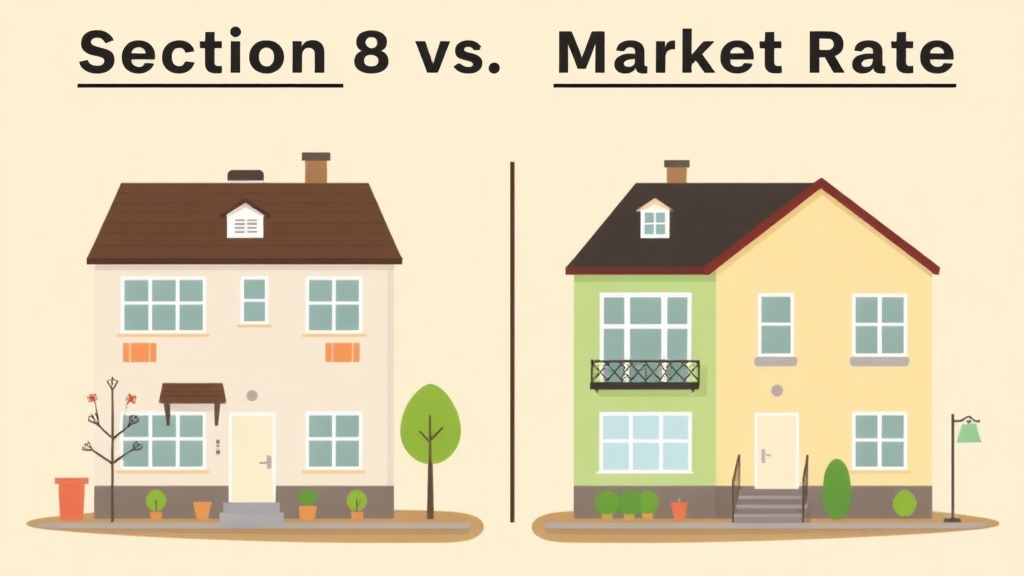
Side-by-Side Comparison
| Factor | Section 8 | Market Rate |
|---|---|---|
| Rent amount | At or below payment standard | Whatever the market will bear |
| Payment reliability | 60-70% guaranteed by government | 100% dependent on tenant |
| Vacancy rate | 2-4% average | 5-10% average |
| Average tenancy | 4-7 years | 2-3 years |
| Inspections | Annual or biennial (mandatory) | None required (self-managed) |
| Paperwork | HAP contract, PHA communication | Standard lease only |
| Tenant screening | You screen + PHA verifies eligibility | You screen only |
| Rent increases | Must be approved by PHA | Per lease terms and state law |
| Eviction process | Standard + PHA notification | Standard process |
| Maintenance standard | Must meet HQS/NSPIRE at all times | Must meet state habitability standards |
When Section 8 Makes More Sense
Section 8 is the better choice in markets where the payment standard is close to or equal to market rents. In these areas, you get the same rent as market rate but with reduced vacancy risk and guaranteed payments. This is common in mid-tier markets, suburban areas, and many Midwestern and Southern cities.
Section 8 also makes more sense for landlords who value predictability over maximum rent. If your investment strategy depends on consistent cash flow to cover mortgage payments, the reliability of HAP payments is a significant advantage.
Properties in working-class neighborhoods that would attract similar tenants at market rate often perform better in the Section 8 program because the government payment guarantee eliminates the biggest risk factor.
When Market Rate Makes More Sense
In hot rental markets where rents significantly exceed the PHA payment standard, market rate may produce higher income. If your 2-bedroom rents for $2,200 on the open market but the payment standard is $1,500, you are leaving $700 per month on the table by going Section 8.
Market rate also makes sense if you are unwilling to deal with PHA inspections and paperwork. Some landlords value the simplicity of a standard landlord-tenant relationship without government involvement.
The Hybrid Approach
Many multi-property landlords run a mix of Section 8 and market-rate units. This diversifies income streams. The Section 8 units provide stable baseline income with government backing. The market-rate units capture higher rents in strong markets. If one segment softens, the other helps maintain overall portfolio performance.
The Inspection Factor
The biggest operational difference between Section 8 and market rate is the inspection requirement. Section 8 units must pass government inspections on a regular schedule. Market-rate units only need to meet general habitability standards under state law, which are typically less detailed.
For landlords who already maintain their properties well, the inspection requirement is not a burden. If your property would pass a thorough home inspection, it will likely pass a Section 8 inspection. The landlords who find inspections burdensome are usually those who have deferred maintenance.
VoucherReady makes the inspection compliance side of Section 8 simple, so you can enjoy the financial benefits without the management headaches.
Related Articles
- ROI of Section 8 Rentals
- Getting Started as a Section 8 Landlord
- Cash Flow Analysis for Section 8 Properties
Try our free tools
Frequently Asked Questions
How do they compare in terms of section 8 vs market rate tenants?
When Section 8 Makes More Sense?
When Market Rate Makes More Sense?
What should I know about the hybrid approach?
Many multi-property landlords run a mix of Section 8 and market-rate units. This diversifies income streams. The Section 8 units provide stable baseline income with government backing.